Posts

Showing posts with the label #cjhfinancialplanning

How to Achieve a Million Dollars by Investing

Image
It is often said that the first million is always the hardest . Assuming you are building your wealth from scratch and not raking in a six-figure monthly income like a professional footballer, you may have bills to pay, family to feed, and risks to worry about.  So how can you do it in a reasonable amount of time? The answer is simple (but not easy) - Discipline and Compound Interest . Firstly, we need to instill the discipline of "paying yourself first". This means setting aside a non-negotiable proportion of your income into investments every payday. I recommend 10-20%, but you can do more if you wish to. This money must not be touched for any purpose other than for growing it. Next, we need to choose where to invest this money, and use the effect of compounding to grow it.  As Albert Einstein said, " Compound interest is the eighth wonder of the world. He who understands it, earns it. He who doesn't, pays it. " The type of instrument that you invest in makes...
Investing vs Speculation

Image
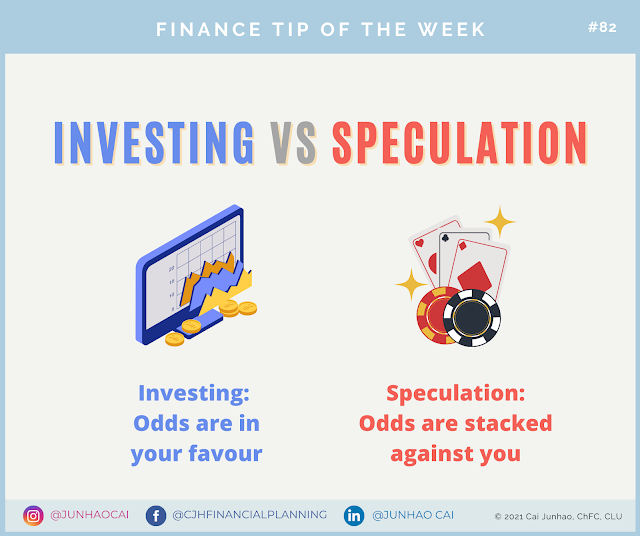
"Investing should be more like watching paint dry or watching grass grow. If you want excitement, take $800 and go to Las Vegas.” - Paul Samuelson And indeed, the stock market has turned into a casino with all the hype around "meme stocks" like GameStop, AMC, and most recently, Robinhood. However, never confuse speculation with investing. They are two totally different approaches. Speculation involves trading (buying and selling) financial instruments, usually high risk in nature, for short term gains. Speculators love price volatility and are not concerned with long term growth.  Investment involves buying and holding assets for the long run, to achieve capital gain and/or income. Investors are more concerned with the fundamentals of the company or asset that they are buying, and are more willing to ride out short-term market fluctuations. As professional financial practitioners, we advocate investing instead of speculation, simply because it works.  "The financial...

Inflation is an invisible thief

Image
Inflation is an invisible thief. You may not see it or hear it, but slowly and surely, it is stealing your future from you. Rising prices in everything around us, from a simple plate of chicken rice to your million-dollar condominium, reduces the purchasing power of our money over time. Do you know that at an inflation rate of 2.5%, $100k saved in the bank over 20 years would only be worth about $60k! That is a 40% loss in purchasing power!  On the other hand, $100k invested in the S&P 500 (comprising the top 500 companies in the US) would have grown to $318k during the same period. There's no guarantee that you will make money from investing, but you are guaranteed to lose money by doing nothing! Long gone are the days where our grandparents stashed their hard-earned savings into biscuit tins. Banks came along, and it became commonplace to open a savings deposit account instead as they used to pay a decent interest rate.  Today, whereby interest rates are close to zero, k...

Don't Spend Money On Things You Don't Need This Black Friday

Image
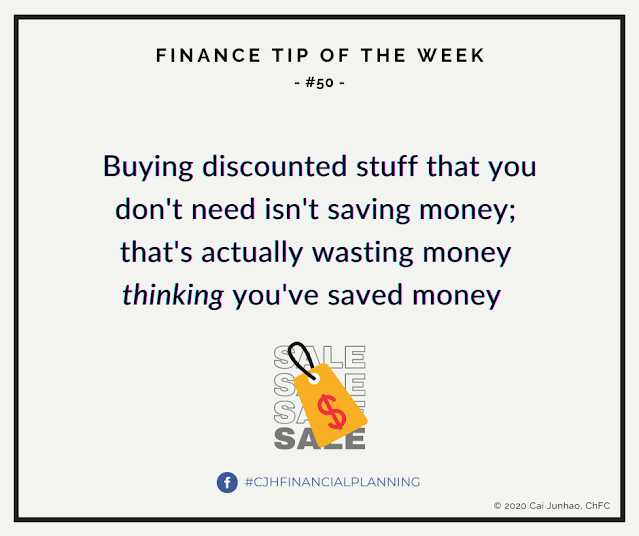
Today is Black Friday and there’s many irresistible discounts everywhere. It is probably the best time of the year to buy something you have been eyeing for a while or stock up on necessities and consumables (skincare anyone?). However, unbeknownst to many, this one-day frenzy also creates a psychological effect known as the scarcity mentality . We are afraid to lose out on the  too-good-to-miss deals and make purchase decisions much more loosely than normal. This can influence us to buy unnecessary stuff that we might not even give a second look on any other day. Buying a $100 on a 20% discount is not saving you $20; it’s spending you $80! In the end, we spend more than we save.  So don’t be unconsciously led to waste your hard-earned money on things you don’t need, or already own too much of. Practise responsible consumerism; buy only what you need. Consider giving away or donating your stuff before buying new ones. That way, you prevent the clutter from piling up, free...