Posts

Showing posts with the label investing

How to Achieve a Million Dollars by Investing

Image
It is often said that the first million is always the hardest . Assuming you are building your wealth from scratch and not raking in a six-figure monthly income like a professional footballer, you may have bills to pay, family to feed, and risks to worry about.  So how can you do it in a reasonable amount of time? The answer is simple (but not easy) - Discipline and Compound Interest . Firstly, we need to instill the discipline of "paying yourself first". This means setting aside a non-negotiable proportion of your income into investments every payday. I recommend 10-20%, but you can do more if you wish to. This money must not be touched for any purpose other than for growing it. Next, we need to choose where to invest this money, and use the effect of compounding to grow it.  As Albert Einstein said, " Compound interest is the eighth wonder of the world. He who understands it, earns it. He who doesn't, pays it. " The type of instrument that you invest in makes...
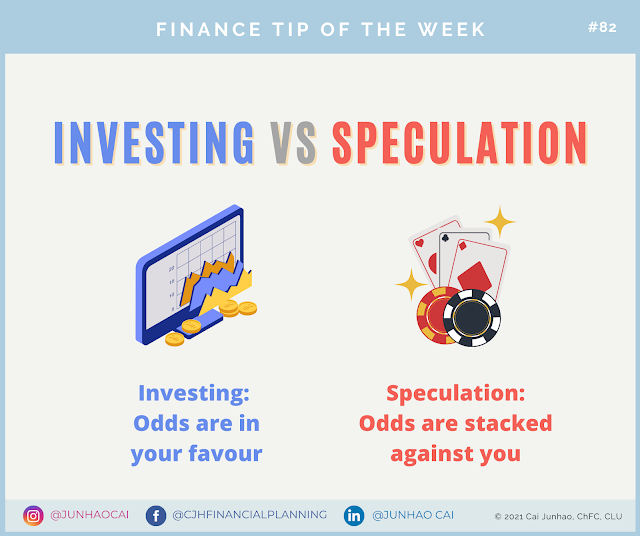
Investing vs Speculation

Image
"Investing should be more like watching paint dry or watching grass grow. If you want excitement, take $800 and go to Las Vegas.” - Paul Samuelson And indeed, the stock market has turned into a casino with all the hype around "meme stocks" like GameStop, AMC, and most recently, Robinhood. However, never confuse speculation with investing. They are two totally different approaches. Speculation involves trading (buying and selling) financial instruments, usually high risk in nature, for short term gains. Speculators love price volatility and are not concerned with long term growth.  Investment involves buying and holding assets for the long run, to achieve capital gain and/or income. Investors are more concerned with the fundamentals of the company or asset that they are buying, and are more willing to ride out short-term market fluctuations. As professional financial practitioners, we advocate investing instead of speculation, simply because it works.  "The financial...

Inflation, Is It Good or Bad?

Image
  We are seeing rises in inflation across many major economies. Inflation in the United States hit 5.4% in May, the highest in 13 years. (Source: WSJ) Back home in Singapore, CPI inflation rose 2.1% in April, higher than expected. (Source: ING) Inflation has usually been seen as a bad thing; something that steals money from under our noses, like an invisible thief. However, do you know that inflation can be a good thing too? Just like a gun; inherently, it is neither good nor bad. It all depends on the intention of the user. Law enforcement officers use guns to maintain order. On the other hand, criminals use guns for undesirable activities. Inflation is defined as a general increase in prices. This affects the goods and services that we buy and use on a day-to-day basis. The Consumer Price Index (or 'CPI') tracks a basket of goods and services and compares the changes in price with the previous month/year. If you keep money in the bank, you're probably getting about 0.05% ...

Inflation is an invisible thief

Image
Inflation is an invisible thief. You may not see it or hear it, but slowly and surely, it is stealing your future from you. Rising prices in everything around us, from a simple plate of chicken rice to your million-dollar condominium, reduces the purchasing power of our money over time. Do you know that at an inflation rate of 2.5%, $100k saved in the bank over 20 years would only be worth about $60k! That is a 40% loss in purchasing power!  On the other hand, $100k invested in the S&P 500 (comprising the top 500 companies in the US) would have grown to $318k during the same period. There's no guarantee that you will make money from investing, but you are guaranteed to lose money by doing nothing! Long gone are the days where our grandparents stashed their hard-earned savings into biscuit tins. Banks came along, and it became commonplace to open a savings deposit account instead as they used to pay a decent interest rate.  Today, whereby interest rates are close to zero, k...

What Singapore’s COVID-19 Response Taught Us About Savings and Reserves

Image
  "It never rains but it pours" This idiom perfectly describes the COVID-19 situation which hit the world badly at the beginning of the year. Fast forward the months, and we are now in December, a year from the initial outbreak of the novel coronavirus. In March 2020, the World Health Organisation announced COVID-19 as a pandemic, leading to many countries locking down their economies, barring their citizens from leaving their homes other than for essential services, and grinding international travel to a halt. Singapore, the tiny city-state, was not spared. With a tiny domestic market and an economy that is highly dependent on import and export, Singapore’s Ministry of Trade and Industry (MTI) projects that the economy will be shrinking between 6% to 6.5% this year. Drawing from Past Reserves It is reasonable to say that the economic impact would probably have been much worse, if not for the 4 sets of stimulus packages (“Budgets”) to help businesses and individuals w...

8 Tips To Help You Be On F.I.R.E

Image
In case you haven't heard of the F.I.R.E movement 🔥 🔥 🔥 , it is spreading like wildfire worldwide right now. For the uninitiated, F.I.R.E stands for Financial Independence, Retire Early . Many have dreamt of retiring early and enjoying the rest of their lives sipping a cocktail on the Bahamas. But dreaming alone isn't going to make it happen - you need to TAKE ACTION! It's hard, but life will be so sweet once you get there. Here are 8 tips to help you get fired up (pun intended 😆 ). #1 - Start saving aggressively I have seen F.I.R.E. advocates saving between 30% to 60% of their income. The more you save, the more you can invest and grow your wealth! #2 - Cut unnecessary spending Live like a minimalist (check out The Minimalists ). Practise delayed gratification - do you really need that Apple Watch now? A dollar that you don't spend is an extra dollar that can be invested to make more money. #3 - Have multiple sources of income Don't depend solely on your salar...

Human's Financial Behaviour Explained (Via Monkeys)

Image
Just came across a thought provoking video on TED about how humans often make illogical financial decisions. Little did we know that we aren't so different from monkeys after all... Check out the video below:

How Unit Trusts Can Add Value To Savvy Investors' Portfolios

Unit Trusts (UTs) or mutual funds seem like investment vehicles for the layperson with little or no investing experience. So how do they fit into a savvy investor's portfolio? Firstly, let's examine the unique characteristics of UT investing: - UTs pool together investors' money to buy assets such as shares and bonds. This allows investors with small capital (even $100) to start investing. - There are thousands of UTs in the market, covering a variety of asset classes, geographical regions, sectors, and industries. - UTs are professionally managed by a Fund Manager, and relieve the investors of the active monitoring and trading of their investments. - UTs charge annual management fees, usually about 1 to 2 percent of the asset under management (AUM). This fee is taken out from the AUM, which cause the Net Asset Value (NAV) of the fund to go down. Most funds are priced based on their NAV, and therefore annual management fees indirectly causes the value of an inve...

Financial Planning for Couples

Getting married involves financial commitments, so get them right to ensure a harmonious life journey together. Here are some findings from a survey conducted by the American Institute of CPAs. More than half of couples argue over unexpected expenses More than one-third of couples fight over insufficient savings Couples aged 45 to 54 argue an average of 4 times a month about finances As you can see, money worries can be a strain on a relationship. Hence, sound financial planning and good money management is integral to a successful and harmonious marriage.

6 Tips to Investing Success

Image
Tip #1 - Getting Your Asset Allocation Right Many investors over-emphasize the importance of picking the right company or bond or country to invest in. There is an equally large group that thinks the correct timing of the markets is the key factor to making profits. Well, they are wrong. According to research, security selection and market timing are not the key contributors to investment profits. In fact these two combined only accounts to less than 5% of investment performance! No wonder most people lose money investing. The most critical factor that contributes to over 90% of investment performance is Asset Allocation . Placing your money in a diversified portfolio across different asset class in the right proportions is the key to investment profits. We have some backtested results (see chart below) showing the difference in performance between 4 of our company's well-allocated portfolios and relevant benchmarks. You will see that the our portfolios performed be...

Investopedia Staff's Fatherly Financial Advice

This is a wonderful article which I came upon and I thought of sharing with everyone.  Original article at:  http://www.investopedia.com/financial-edge/0612/Investopedia-Staffs-Fatherly-Financial-Advice.aspx#axzz1y4PLPi11      - CJH Since Father's Day is quickly approaching, we here at Investopedia wanted to honor our dads by sharing some stories about the best financial lessons our fathers taught us. We cover everything from budgeting to employment advice, and we will hopefully show you that your dad's advice - though it may have seemed curmudgeonly at the time - can help you out throughout your entire life. Feel free to share your own stories in the comments section. Each of these stories has been shared by an individual from the Investopedia Staff. Happy Father's Day!

Don’t be clueless. Be in control.

Image
Do you know someone who is a slave to his job because of the big mortgages he has to pay? Someone who could not afford the best medical care when diagnosed with cancer?  Someone who is broke due to speculative investing? Someone whose marriage fell apart because of financial stress? Someone who has to get a court order for financial support from her children? Could that someone be you someday? Don`t let it happen!

A Quick Guide to Investing in Unit Trusts

How do you ensure that you profit from unit trust investments and minimize the chance of losses? Here are 7 golden rules to follow: This article is contributed by a friend, fellow financial professional and colleague from Business Network International , Mr Daniel Tay.

Singapore Inflation Rises 5.5%, Bank Deposits Interest Rates Drops

Image
Singaporeans are experiencing a 'double whammy' recently. Firstly, Yahoo! News reported that Singapore’s inflation have risen by 5.5 per cent over one-year period. Read the whole article here:  http://bit.ly/oZyZus Secondly, a major local bank has decreased the interest rates for savings and fixed deposit accounts. Savings Deposit Rates Fixed Deposit Rates If majority of one's long-term money (money which is not needed in the short term and used for purposes such as retirement or children's education) are in such accounts, they are subject to rapidly losing their real value .  A double whammy of lower interest earnings (therefore higher opportunity costs should one be able to invest elsewhere) and higher inflation (the 'purchasing power' of money shrinking). Compounded over years, one's savings will shed half, or even more of its value. If one day you wake up and find that your bank balance has halved, would you be concerned? Definitely! So...

The Pitfalls of Starting Your Savings Late

Image
This post is written to help some of my clients who is in a dilemma of whether they should start their savings as soon as they can, or to wait till they are married and settled down before starting. The answer is obviously to start early. We have heard it so many times but why is starting early so important, and what are the pitfalls if we start late? TIME VALUE OF MONEY (TVM) A dollar today is not worth the same dollar in 10 years' time. This is because of opportunity cost lost through the interest that was not earned, and time is really money. Let's use a story to illustrate the point of 'Time Value of Money'. Mary and John are both 25 years old and are unmarried, and they intend to save and invest $500 per month and to use the savings for to fulfill their financial goals (pay for their children's tertiary education, fund their retirement, start a business, etc) in 30 years' time. Mary starts saving from now , and saves for 15 years, and stops saving...

Why The Poor Gets Poorer

Image
Source: Wallstraits.com There is an old saying:  The rich get richer and the poor get poorer. It's true, and there's a logical explanation why it holds true in every capitalist society. Put simply: the rich understand the difference  between an asset and a liability, and the poor never quite get it. The rich work for investment capital, while the poor work for disposable income. The rich buy appreciating assets and allow returns to compound, while the poor buy depreciating assets and live paycheck to paycheck. The rich live a bit below their means until their compounding investment returns supply enough passive income to support a lavish lifestyle, while the poor live just at their means throughout their lives. I was reminded of the stark distinction between the haves and the have-nots when the Straits Times newspaper carried a cover story about the new Singapore Shares and featured a large color photo of a long line of poor and elderly waiting to cash i...

CPFIS-included funds sees 6.8% gain in Q3 (from IM$aavy)

Source: The Straits Times, Lorna Tan Funds held in the Central Provident Fund Investment Scheme (CPFIS) achieved average gains of 6.8 per cent in the three months ended in September, thanks to rallying global equity markets.

The True Opportunity Cost of Owning a Car

Many young people go all out an buy a car soon after they start their first job. In Singapore (where I live), the cost of owning a car is very high. In fact, a mid-range car... Read more: http://thefirstmillion.net/blog/?p=5

Buffett's is 'best' US company

Came across this article 5 minutes ago and thought I'll share it with you guys. Though it is a short and brief article, I wish to highlight 2 important points. 1. Warren Buffett, though super rich, is a frugal person. How many people we know try to spend lavishly on lots of material things just to 'look rich', but in fact if you take a closer look at their bank account, they're really BROKE! 2. Warren Buffett is good at investing! Damn good! How? Firstly he believes in value investing. Instead of trying to go after the next 'hot tip' (be it on stocks or even football!), he knows the difference between value and price. Many people only see the price, and it is the most misleading thing to look at! Prices of stock changes EVERY SINGLE DAY! But NOT! So we must all learn how to judge value, like Mr Buffett. 3. (actually a continuation of the above point) Warren Buffett believes in LONG TERM INVESTING. His favorite holding period is 'forever!' (Yes, he ...

Time for Prosperity and Wealth

First of all, "Gong Xi Fa Cai" to all Chinese readers! Chinese New Year is a time where greetings of wealth and prosperity is heard all over. And how aptly so, expecially in this Year of the Tiger. Why? A few weeks back, the stock market has taken a slight tumble on news that banks in China may be tightening its purses. Commodity prices have also fell. (I'm following the gold and silver prices day in, day out.) Well, seems like the markets may be presenting a good chance for us to enter, right? Yes, and no. Yes because it's always good to buy things, especially investments, at a lower price. No because it is not necessary. First of all, I wish to announce that I am not saying that this is the lowest price and that it is the 'perfect' time to buy in. I do not claim to be a guru of investing or an expert in timing the markets. I go for long term investing and I do not speculate on short term trends. Last week, during a business appointment, my clie...