Posts

How to Achieve a Million Dollars by Investing

Image
It is often said that the first million is always the hardest . Assuming you are building your wealth from scratch and not raking in a six-figure monthly income like a professional footballer, you may have bills to pay, family to feed, and risks to worry about.  So how can you do it in a reasonable amount of time? The answer is simple (but not easy) - Discipline and Compound Interest . Firstly, we need to instill the discipline of "paying yourself first". This means setting aside a non-negotiable proportion of your income into investments every payday. I recommend 10-20%, but you can do more if you wish to. This money must not be touched for any purpose other than for growing it. Next, we need to choose where to invest this money, and use the effect of compounding to grow it.  As Albert Einstein said, " Compound interest is the eighth wonder of the world. He who understands it, earns it. He who doesn't, pays it. " The type of instrument that you invest in makes...

Your Financial Life is a Sailboat

Image
Think of your financial life as a sailboat, bringing you from where you are now, to where you want to go in the future. Think of the sails as higher-risk investments, as they help your boat goes fast. These may include stocks, bonds, funds, or other alternative assets. The boat (or the hull) is akin to cash and other low-risk assets like fixed deposits. They keep you safe and stable on your journey. When you have too much sail and too little boat, you are 'windsurfing'. If you have seen windsurfers in action, you will often see them capsizing as the winds topple them over due to their small base. Your boat may break before you reach your goal. On the flip side, if you have too much boat and too little sail, you are not harnessing the power of the wind. Instead, you are rowing your boat by hand. You will find yourself using lots of effort to work the oars just to move the boat a little, and certainly never getting to your destination on time. The key, therefore, is to find a goo...

3 Insurance All Home Owners Must Consider

Image
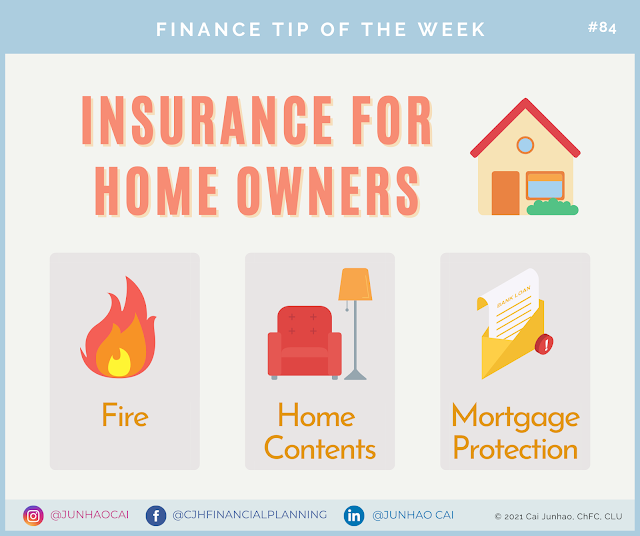
  As a homeowner, our nest is our pride and joy. It is also where we have sunk in a lot of money as well. Therefore we must ensure that our most valuable asset is protected. Here are three types of insurance covers that all home owners must consider. (1) Fire Insurance Fire insurance provides coverage for damage to the building, structures, fixtures, and fittings caused by fire. This is mandatory if you have an outstanding home loan, either with HDB or with a bank. Do note that fire insurance does not cover renovation or improvements, furniture, electrical appliances, and other home contents.  (2) Home Contents Insurance Home contents insurance provides more comprehensive protection and can cover damage to renovations or improvements, home contents, and personal effects such as your watches, computers, or valuables - they can often cost more than the renovation itself. Besides damage to property caused by perils, home insurance can reimburse you for loss should there be a burg...

Advance Medical Directive

Image
If one day you find yourself terminally ill and needing life support to survive, would you want your doctors to turn off the machine? Some people may prefer to go naturally and in peace, while others may not want to burden their family with a mountain of medical bills to settle. If your answer is "yes", you may consider doing an Advance Medical Directive (AMD) . An AMD is a legal document that you sign when you're still mentally sound, informing your doctor that you do not want the use of any " extraordinary life-sustaining treatment " to prolong your life in the event that you become terminally ill and unconscious. An AMD is not the same as "euthanasia", because an AMD involves stopping artificial life-sustaining support in a situation where there is no real possibility of recovery and death is imminent. It can only come into force when three doctors unanimously certify a patient's terminal illness. An AMD is a voluntary and confidential decision...

Investing vs Speculation

Image
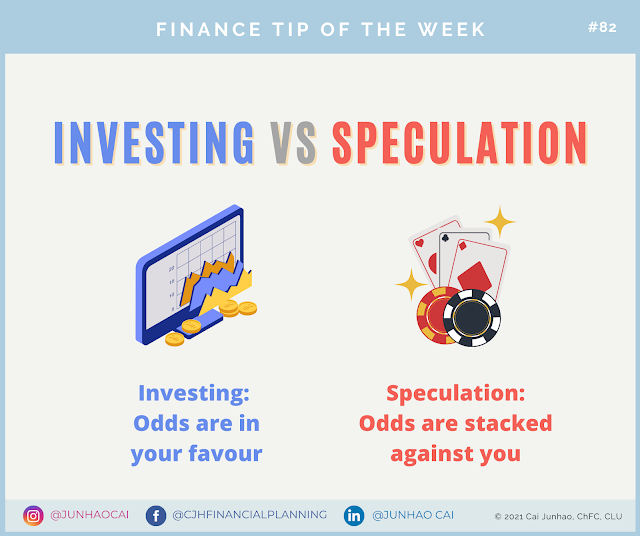
"Investing should be more like watching paint dry or watching grass grow. If you want excitement, take $800 and go to Las Vegas.” - Paul Samuelson And indeed, the stock market has turned into a casino with all the hype around "meme stocks" like GameStop, AMC, and most recently, Robinhood. However, never confuse speculation with investing. They are two totally different approaches. Speculation involves trading (buying and selling) financial instruments, usually high risk in nature, for short term gains. Speculators love price volatility and are not concerned with long term growth.  Investment involves buying and holding assets for the long run, to achieve capital gain and/or income. Investors are more concerned with the fundamentals of the company or asset that they are buying, and are more willing to ride out short-term market fluctuations. As professional financial practitioners, we advocate investing instead of speculation, simply because it works.  "The financial...

The two types of Insurance Nominations you can make and their differences

Image
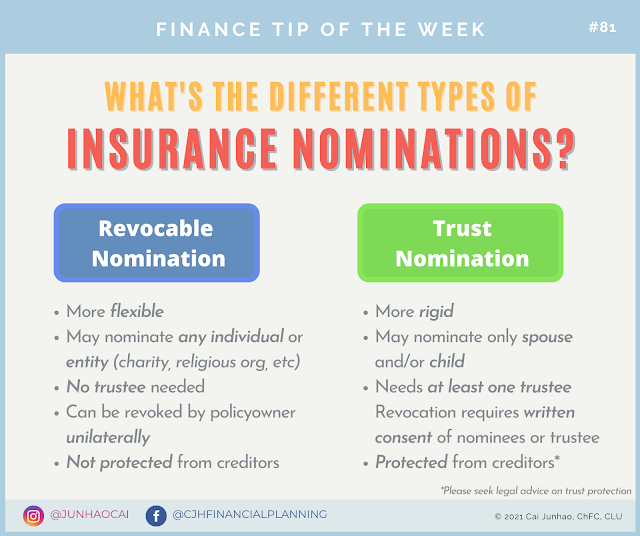
If you own a life insurance policy with death benefit, you may choose your nominees (or beneficiaries) to inherit the insurance proceeds using one of the two types of nominations. ✏️ 𝐑𝐄𝐕𝐎𝐂𝐀𝐁𝐋𝐄 𝐍𝐎𝐌𝐈𝐍𝐀𝐓𝐈𝐎𝐍 (𝐒𝐄𝐂. 𝟒𝟗𝐌) A revocable nomination informs the insurer who to pay the insurance proceeds to, and in what proportion. You may appoint anyone as a nominee, including foreigners or legal entities such as charities, or religious organisations. As the name suggests, it can be "revoked" or terminated anytime that you wish, without permission from nominees. Nominees will only receive the death benefit , while the living benefits belong to the policyowner. Take note that if you make a Will after doing a revocable nomination, it will supersede the instructions in the nomination. ✒️ 𝐓𝐑𝐔𝐒𝐓 𝐍𝐎𝐌𝐈𝐍𝐀𝐓𝐈𝐎𝐍 (𝐒𝐄𝐂. 𝟒𝟗𝐋) A trust nomination serves the same purposes in informing the insurer who to pay to. However, you can only nominate your spouse and/...

Levelling Up Your Critical Illness Coverage to Multi-Pay

Image
Did you know that Critical Illness (CI) insurance was invented by a cardiologist?  Dr. Marius Barnard saw his patients fall into financial hardship after the expensive treatments. After years of garnering support from insurers, the first CI policy was launched in 1983, covering 4 illnesses: heart attack, cancer, stroke, and coronary artery surgery. Today, the number has expanded to 37, including conditions such as coma, brain tumour, kidney failure, and others.  In 2008, the first early-stage CI policy was launched and is now a common feature in all CI policies today. Based on our latest claim statistics, about 50% of CI  claims are for clients aged between 46 to 55 , and about 30% for those between 36 to 45 . As you can see, these claimants are relatively young.  The incidence rate of diseases such as heart attack and cancer among the young is on the rise. Even a super fit 29-year old professional footballer can collapse suddenly from cardiac arrest (get well soo...

Inflation, Is It Good or Bad?

Image
  We are seeing rises in inflation across many major economies. Inflation in the United States hit 5.4% in May, the highest in 13 years. (Source: WSJ) Back home in Singapore, CPI inflation rose 2.1% in April, higher than expected. (Source: ING) Inflation has usually been seen as a bad thing; something that steals money from under our noses, like an invisible thief. However, do you know that inflation can be a good thing too? Just like a gun; inherently, it is neither good nor bad. It all depends on the intention of the user. Law enforcement officers use guns to maintain order. On the other hand, criminals use guns for undesirable activities. Inflation is defined as a general increase in prices. This affects the goods and services that we buy and use on a day-to-day basis. The Consumer Price Index (or 'CPI') tracks a basket of goods and services and compares the changes in price with the previous month/year. If you keep money in the bank, you're probably getting about 0.05% ...

The Power of Delayed Gratification

Image
  The Marshmallow Experiment In 1972, Stanford University conducted an experiment on children aged 3-4. Each kid was brought to an empty room with a marshmallow on the table in front of them. They were told that they can either have a marshmallow now or if they waited 15 minutes without giving in to the temptation, they can have 2 marshmallows. Some kids were unable to resist their temptation and ate the marshmallow in front of them. A small handful of the kids were able to stay disciplined and managed to wait out the entire 15 minutes. The Stanford researchers continued to track these kids as they grow up (they would be in their 50s today). What is astounding is the kids who practised delayed gratification are more successful in life. They had higher SAT scores, able to cope better with frustration and stress, more academically and socially competent, and generally better in a variety of life measures. A 2011 brain imaging study on the original Standford participants also showed a...

Inflation is an invisible thief

Image
Inflation is an invisible thief. You may not see it or hear it, but slowly and surely, it is stealing your future from you. Rising prices in everything around us, from a simple plate of chicken rice to your million-dollar condominium, reduces the purchasing power of our money over time. Do you know that at an inflation rate of 2.5%, $100k saved in the bank over 20 years would only be worth about $60k! That is a 40% loss in purchasing power!  On the other hand, $100k invested in the S&P 500 (comprising the top 500 companies in the US) would have grown to $318k during the same period. There's no guarantee that you will make money from investing, but you are guaranteed to lose money by doing nothing! Long gone are the days where our grandparents stashed their hard-earned savings into biscuit tins. Banks came along, and it became commonplace to open a savings deposit account instead as they used to pay a decent interest rate.  Today, whereby interest rates are close to zero, k...

What Singapore’s COVID-19 Response Taught Us About Savings and Reserves

Image
  "It never rains but it pours" This idiom perfectly describes the COVID-19 situation which hit the world badly at the beginning of the year. Fast forward the months, and we are now in December, a year from the initial outbreak of the novel coronavirus. In March 2020, the World Health Organisation announced COVID-19 as a pandemic, leading to many countries locking down their economies, barring their citizens from leaving their homes other than for essential services, and grinding international travel to a halt. Singapore, the tiny city-state, was not spared. With a tiny domestic market and an economy that is highly dependent on import and export, Singapore’s Ministry of Trade and Industry (MTI) projects that the economy will be shrinking between 6% to 6.5% this year. Drawing from Past Reserves It is reasonable to say that the economic impact would probably have been much worse, if not for the 4 sets of stimulus packages (“Budgets”) to help businesses and individuals w...

Don't Spend Money On Things You Don't Need This Black Friday

Image
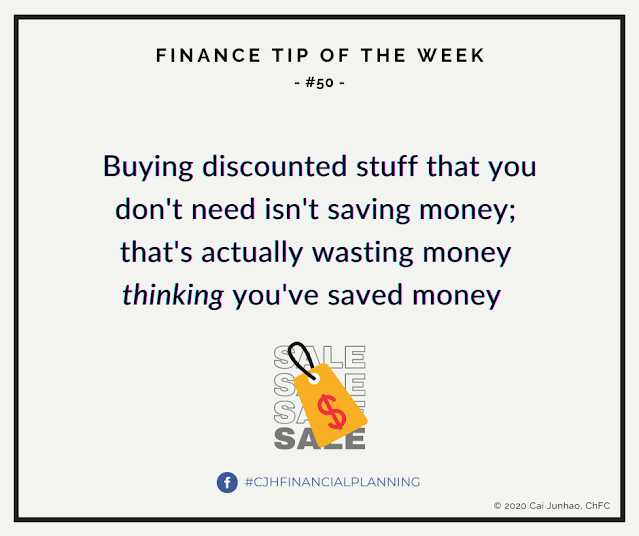
Today is Black Friday and there’s many irresistible discounts everywhere. It is probably the best time of the year to buy something you have been eyeing for a while or stock up on necessities and consumables (skincare anyone?). However, unbeknownst to many, this one-day frenzy also creates a psychological effect known as the scarcity mentality . We are afraid to lose out on the  too-good-to-miss deals and make purchase decisions much more loosely than normal. This can influence us to buy unnecessary stuff that we might not even give a second look on any other day. Buying a $100 on a 20% discount is not saving you $20; it’s spending you $80! In the end, we spend more than we save.  So don’t be unconsciously led to waste your hard-earned money on things you don’t need, or already own too much of. Practise responsible consumerism; buy only what you need. Consider giving away or donating your stuff before buying new ones. That way, you prevent the clutter from piling up, free...

8 Tips To Help You Be On F.I.R.E

Image
In case you haven't heard of the F.I.R.E movement 🔥 🔥 🔥 , it is spreading like wildfire worldwide right now. For the uninitiated, F.I.R.E stands for Financial Independence, Retire Early . Many have dreamt of retiring early and enjoying the rest of their lives sipping a cocktail on the Bahamas. But dreaming alone isn't going to make it happen - you need to TAKE ACTION! It's hard, but life will be so sweet once you get there. Here are 8 tips to help you get fired up (pun intended 😆 ). #1 - Start saving aggressively I have seen F.I.R.E. advocates saving between 30% to 60% of their income. The more you save, the more you can invest and grow your wealth! #2 - Cut unnecessary spending Live like a minimalist (check out The Minimalists ). Practise delayed gratification - do you really need that Apple Watch now? A dollar that you don't spend is an extra dollar that can be invested to make more money. #3 - Have multiple sources of income Don't depend solely on your salar...

Credit Ratings of Life Insurers in Singapore 2020

Image
This is a follow-up from a post 3 years ago , where I compiled the credit ratings of the life insurers in Singapore, to have an idea of the differences in terms of their credit worthiness. Flawed Assumption People often think that life insurers and the policies they issue are homogeneous (the same), and often compare benefit illustrations as if two companies are going to make the exact same amount of profits, exact same amount of investment returns, have the exact same amount of business operating costs, and et cetera. How far away from the truth that flawed assumption can be.  Every life insurer holds a different asset mix in their insurance funds, and have different profits/returns/costs. Even their shareholders may demand a different dividend rate on their shares. Therefore it is not surprising that life insurers with larger assets and bigger operations in Singapore tend to be the ones rated higher by Standard and Poors (S&P), one of the foremost rating agency in th...

Is Your Critical Illness Insurance Enough? Here's 4 Steps to Find Out.

Image
Critical Illness (CI) insurance - most of us have it. And many think that they have sufficient coverage. Besides, who in the right mind would want to sit down with a financial planner and talk about diseases such as cancer, heart attack, stroke, or kidney failure befalling upon us and our family?  Why people don’t buy enough CI insurance  When I meet clients in their twenties, a common response is that they are fit and healthy and nothing will happen to them.  When it comes to clients in their thirties, they would justify that they have housing and family commitments and they would prefer to focus on those at the moment. And since they are still relatively young, CI insurance is not an important priority yet.  When clients in their forties come and see me, they come with sincerity and recognise that illness is fast becoming more of a possibility — they see their friends getting this-and-that. That worries them. However their age is higher now, and so...

Financial Planning Is Not About Buying Insurance Policies

Image
Today a business friend asked me if there is any way to insure her parents, who are in their late 70s, against medical costs. I told her that unfortunately the policies at my disposal have a maximum entry age of 75, and therefore I’m not able to provide cover for them. However I advised her on a viable alternative, that is “self-insurance”. I asked if she has any other siblings and she replied yes. I then went on to suggest that from now on, she and her siblings should start contributing some money into a medical fund for their parents, and this pool of money becomes an “insurance fund” for them. Coupled with Medishield Life as well as their Medisave funds, this approach should help to alleviate most of the medical costs. Suddenly I can see an imaginary light bulb lit up in her mind — an “a-ha” moment! She said that if each sibling contribute $200 monthly, it seems like this is a do-able strategy. Financial planning isn’t always about buying more insurance policies. Sometimes...

Credit Ratings of Insurers in Singapore 2017

Image
I got curious about the different credit ratings across Singapore's life insurer and started to compile the data. Here is the result of my curiosity. Standard and Poors (S&P) is one of the top three credit rating agencies in the world (alongside Fitch and Moody's) and their opinion is highly regarded in the financial and economic world. The ratings are a reflection of S&P's opinion on how likely a company is able to meet its financial obligations. In the context of insurance companies, that means the policy payouts and cash values. To give a better perspective of the credit worthiness, all three local banks (DBS, UOB, OCBC) are rated AA- ( http://www.straitstimes.com/business/banking/dbs-ocbc-uob-get-aa-credit-rating-from-sp ). In the case of the latest entrant in the market (FWD Singapore), it's apparent that their credit rating is way lower than the other more established brands.  (Note that FWD's rating is by Fitch, which runs on an equivalent sca...

Top 5 Most Popular Insurance Policies

Image
As I approach my tenth year in the life insurance and financial advisory business, it has come to a point in my career where I am embarking on a new challenge, that is to groom and train young people into successful financial consultants. As such, I have been away from writing articles for a while, busy juggling both client consulting and mentoring responsibilities. All newly minted financial consultants have to undergo intensive product training, mastering one product at a time, until they reach a level of proficiency and experience where they can flap their wings and fly on their own. While I was training the new blood of our industry, it is inevitable that that the new consultants ask which products do our clients like the most. Although financial planning is a highly customised affair, and no two persons' financial needs are exactly the same, some products are indeed in higher demand than the rest. This may be due to a greater awareness for certain types of policies. And du...

Term Life Insurance - Not All Are Made The Same.

Image
Last week, a client asked me to help examine a very affordable type of term life insurance policy that all Singapore NS-men are entitled to purchase - Aviva SAF Group Term Life policy. He wanted to know if it is a better deal as compared to the other term insurance plans out in the market. First and foremost, it is a common misconception that all term life insurance policies are the same. It is also incorrect to assume that since all term policies are the same (which is not true), then the one with the cheapest premium is the best. Different insurance policies have different wordings, and what may be claimable from one policy may not be claimable from another. Also, different insurance companies differs in claim experience, cost of operations and distributions, size of their life funds, and investment performance. When it comes to service, different insurers also differs in continuous client engagement, speed and ease of claims, and personalised custo...